Introduction A couple of years back, we would have told you that profiting from AI required a computer science degree, a venture-backed budget, or, at a minimum, a very patient employer willing to fund experiments. None of that holds today. Yes, you can make money with AI tools. The professionals cashing in on AI right […]
A couple of years back, we would have told you that profiting from AI required a computer science degree, a venture-backed budget, or, at a minimum, a very patient employer willing to fund experiments. None of that holds today. Yes, you can make money with AI tools.
The professionals cashing in on AI right now aren’t mostly engineers. They’re marketers who figured out that writing ten pieces of content a day is now actually possible. They’re consultants who realized their clients were drowning in AI confusion and needed someone — anyone — to just tell them what to do.
What’s funny is that very few of them had a master plan. Most stumbled into it. They tried one tool, got a result that surprised them, and kept going from there.
If you are planning to start, this guide lays out the most practical ways. Plus, the pitfalls that slow most people down before they ever see a return.
Straight answer: yes. And we’re well past the phase where that needs a lengthy disclaimer attached.
What’s worth understanding is how it works — because there’s more than one model here, and the right one depends on where your skills already sit.
Some people build careers directly inside AI — engineers, researchers, and product managers who shape the technology itself. Glassdoor puts AI product manager salaries around $159,000 and AI engineers near $138,500 in the U.S. These are serious, long-term career tracks.
Others — probably most reading this — are more interested in using AI as a professional multiplier. You bring the expertise, industry knowledge, and client relationships. AI handles the heavy lifting on volume and speed. That combination is genuinely powerful, and it’s where most of the near-term income opportunity sits.
Then there’s the product route — creating digital goods with AI and selling them repeatedly. Prompt guides, ebook bundles, design template packs. Build once, sell many times.
None of these paths requires a technical background. All three are producing real income for real people right now.
Here’s a framing that cuts through a lot of the noise: AI doesn’t earn money. People with AI earn money. The distinction matters because it means your underlying expertise still drives outcomes — AI just removes the friction that used to slow you down.
A skilled copywriter who once delivered four articles a week can now deliver fifteen with the same quality bar. A consultant who spent two days on research now spends two hours. That freed-up capacity becomes revenue capacity — more clients, more projects, or simply more margin built into each engagement.
Here’s something most businesses won’t admit publicly: they know they need AI, they’ve allocated budget for it, and they have no idea what to actually do with it. That confusion is the opportunity. Professionals who can walk into a room and say “here’s exactly how AI applies to your workflow” are worth a premium — and that premium is being paid today.
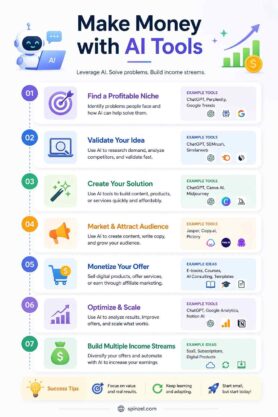
Content work was probably the first thing people monetized with AI, and it remains one of the most accessible entry points. Tools like Jasper, Copy.ai, and ChatGPT handle first drafts of articles, email sequences, social posts, and ad copy faster than any human writer working alone.
The model that works: you own the strategy, the brand voice, and the quality check. AI owns the draft. Clients on Fiverr and Upwork are buying this service daily — rates haven’t collapsed, because quality still separates professionals from amateurs.
Most companies experimenting with AI have the same problem: they’ve read enough to know it matters, but not enough to know where to start. That gap is a consulting opportunity hiding in plain sight.
If you’ve genuinely used these tools in a professional context — built a workflow, improved a process, saved meaningful time — you’re already ahead of most internal teams at small and mid-size businesses. Position yourself as someone who implements rather than just advises, and you’ll find clients faster.
Prompt libraries, niche ebooks, Canva templates, design asset packs —Gumroad and Etsy both have active buyers for AI-generated digital products. The appeal here is obvious: create it once, earn from it repeatedly. The catch is that distribution and marketing matter as much as the product itself.
Businesses want chatbots — for customer service, lead capture, and scheduling. Most don’t have the internal capability to build them. Tools like Botpress and ManyChat make this buildable without deep development skills. Standard pricing runs $1,500–$5,000 for setup, plus monthly retainers for maintenance.
Bigger AI income streams take time to build, and cash flow during that ramp-up period is a real concern. Spinzel’s paid surveys offer something simple: income that doesn’t require a client relationship, a portfolio, or a learning curve. It’s not a career — it’s a bridge.
Check out Spinzel’s best paid survey opportunities here
ElevenLabs for voiceovers, Pictory for video production, Midjourney for visuals — these tools have brought professional-grade creative output within reach of solo operators. You don’t need a studio, a camera, or a design degree to offer services that look like you do.
Tips For Making Money With AI Tools
Yes — and the legal picture here is clearer than a lot of people assume.
The U.S. Copyright Office has confirmed that purely AI-generated content sits in the public domain. No one holds copyright over it, which means selling or monetizing it raises no legal issue. Where you contribute meaningfully — structuring, editing, applying strategic judgment — those contributions can carry copyright protection.
Practically speaking: disclose AI use when your client contract requires it, check commercial terms of service for any tool you use professionally, and always apply your own editorial review before delivery. The framework is workable. Operate within it confidently.
Honest ranges, not inflated ones:
Thirty to sixty days of focused effort is a reasonable timeline for most professionals to generate their first few hundred dollars. Scaling beyond that depends on how well you position, how consistently you deliver, and how actively you market.
There’s no perfect moment to start building income with AI. There’s just the moment you decide the opportunity is real enough to act on — and this one is.
The tools are accessible. The demand is there. What the market keeps rewarding is professionals who show up with genuine skill, apply it with quality, and stay consistent long enough to build a track record.
Here’s a practical starting point:
The professionals who look back on this moment as a turning point won’t be the ones who planned the longest. They’ll be the ones who started first.
1. What is the easiest way to make money with AI as a beginner?
Start with AI-assisted content writing or paid surveys on Spinzel. Both require minimal investment and deliver results quickly.
2. Do I need technical skills to make money using AI?
Not at all. Most AI income paths rely on communication and creative judgment, not coding.
3. Can I make money online with AI tools without a website?
Yes — Upwork, Fiverr, and Gumroad let you sell AI-powered work without owning a site.
4. How long does it take to see real income from AI side hustles?
With focused effort, most professionals see meaningful results within 60 to 90 days.
5. Is AI-generated content legal to sell?
Yes. The U.S. Copyright Office confirms AI content is public domain — fully legal to monetize.
6. What AI tools should I start with to make money online?
ChatGPT, Jasper, Midjourney, ElevenLabs, and Pictory are among the most practical starting points.