One of my acquaintances quit her admin job last spring to become a virtual assistant. Six months in, she’s booked out with three clients and turning down work. That’s not a fluke story you see once and forget. It’s happening across LinkedIn, Reddit threads, and freelancer Slack groups every week. Virtual assistant work has turned […]
One of my acquaintances quit her admin job last spring to become a virtual assistant. Six months in, she’s booked out with three clients and turning down work. That’s not a fluke story you see once and forget. It’s happening across LinkedIn, Reddit threads, and freelancer Slack groups every week. Virtual assistant work has turned into one of the more approachable ways to make money as a virtual assistant, and you don’t need a degree, a certification, or ten years of office experience to get in.
You need a laptop. Decent Wi-Fi. And the patience to learn two or three tools well enough to use them without panicking.
This guide walks through what the job actually involves, the skills clients pay for, where the real listings live, and how to price your time without shortchanging yourself.
While you’re building VA skills, paid surveys from Spinzel work well as a side income stream — zero learning curve, quick payouts.
A virtual assistant takes on administrative, creative, or technical tasks for a business owner, remotely. That could mean managing an inbox, booking calls, entering data, answering customer emails, or running an Instagram account for a small brand. Business owners hire VAs because delegating frees them up for the parts of the business only they can do — and hiring remote talent keeps overhead low.
Small business owners run out of hours before they run out of tasks. A work-from-home virtual assistant costs a fraction of a full-time hire and needs zero desk space. That math works in favor of VAs, and it’s why demand keeps climbing across industries — from real estate to e-commerce to coaching businesses.
You don’t need to code or design. Clients care about whether you reply on time, follow instructions properly, and get things done without constant hand-holding. Everything else can be learned on the job.
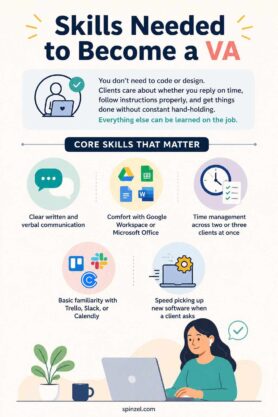
Figuring out how to become a virtual assistant with no experience starts with one skill. Get good at it. Offer it at a fair starter rate to your first client, and let that project become your proof.
VA work isn’t a single lane; it branches into several directions, which is exactly why virtual assistant jobs for beginners feel approachable no matter your background.
Pick one that suits you, and stay there for some time.. Clients trust focused expertise over a jack-of-all-trades pitch, and that trust shows up in your rate.
Paying clients gather in specific corners of the internet. Knowing where to look saves you weeks of scrolling through listings that go nowhere.
For a broader comparison of remote income paths, our guide on how to make money online covers several routes side by side, VA work included.
Your first client rarely comes from a polished resume sitting in an inbox. It comes from showing up where business owners are already looking and making the “yes” easy for them.
Need faster income while this builds momentum? Making money online in 24 hours covers quicker options worth trying alongside your VA search.
Confident pricing sets the tone for every client relationship that follows. Get this part right early, and negotiations, retainers, and future raises all get easier.
Two or three projects with real results behind them give you the standing to raise your rate — and clients rarely push back when the work speaks for itself.
Landing a first client is the beginning, not the finish line. A deliberate push after that first win turns a single project into a real career.
Our freelancing for beginners guide covers fundamentals that stretch well beyond VA work, too.
Virtual assistant work rewards people who show up prepared and stay consistent. It offers a real path toward remote income, transferable skills, and a work life built around your own schedule. Pick one skill. Pick one platform. Land one client. The rest builds from there, faster than you’d expect.
Your actionable next steps:
1. How much can a beginner virtual assistant earn?
Beginners typically earn $8–$25/hour depending on location and skillset. Specializing and building a track record raise rates significantly within a few months.
2. Do I need a certification to become a VA?
Certifications help, but aren’t required. Clients value reliability, communication, and demonstrated skill above formal credentials or degrees.
3. What equipment do I need to start VA work?
A laptop, stable internet, and basic software knowledge cover nearly every starting need, with no major investment required upfront.
4. Can I do VA work part-time alongside a job?
Yes, plenty of VAs start part-time. A few hours weekly is enough to land a first client and test the fit.
5. Which platform works best for beginners?
Upwork works well for beginners thanks to its volume, beginner-friendly listings, and built-in tools for showcasing a growing portfolio.