Every freelance writer I know has the same origin story: they didn’t feel qualified, they applied anyway, and someone said yes before they’d fully convinced themselves they deserved it. That’s the part nobody tells you when you search “how to become a freelance writer.” You’ll find people promising six figures in three months, and you’ll […]
Every freelance writer I know has the same origin story: they didn’t feel qualified, they applied anyway, and someone said yes before they’d fully convinced themselves they deserved it.
That’s the part nobody tells you when you search “how to become a freelance writer.” You’ll find people promising six figures in three months, and you’ll find people insisting you need an English degree and ten years of experience just to submit a pitch. Neither camp is being honest with you. The truth is a lot more boring and a lot more doable: clients don’t care about your credentials; they care about whether you can solve their problem. Show them you can, and the rest follows.
This isn’t a theory piece. It’s what actually works.
Strip away the buzzwords, and it’s this: you write for businesses and people who need words, and nobody puts you on payroll. You pick the clients. You pick the projects. You pick how much of your week goes toward it.
In practice, that means things like:
Once you’ve got a few projects under your belt, the more lucrative lanes open up, such as technical writing, SaaS content, case studies, and white papers. That’s where the per-word rates start looking a lot more interesting, but almost nobody starts there, and that’s fine.
The appeal isn’t complicated. You need a laptop and a willingness to send some pitches, no inventory, no storefront, no six-month runway. You set your own hours. You can work from anywhere with decent wifi. And because businesses never stop needing content, every company with a website is quietly hungry for someone to write for them. The demand doesn’t dry up the way it does in more trend-driven gigs.
None of that means it’s easy. It means the barrier to entry is low, not that the ceiling is low too.
People tend to picture “freelance writer” as one job. It’s really a handful of different skill sets wearing the same job title:
Pick one, maybe two, to get good at early. Trying to be equally good at all six just means you’re mediocre at all six, and clients can tell.
Good grammar gets you in the door. It’s not what keeps you employed.
What keeps you employed is being able to research a topic you knew nothing about yesterday and sound credible about it by tomorrow. It’s answering emails without making a client chase you. It’s hitting deadlines without turning in something rushed. It’s being able to adjust your voice from “playful DTC skincare brand” to “buttoned-up B2B software company” in the same afternoon.
Learn the basics of SEO too, not to become a technical expert, just enough to understand search intent, where keywords naturally belong, and how to structure a piece so it’s actually readable. That alone puts you ahead of a lot of writers who are all comma splices and no strategy.
And if I had to pick one trait that separates writers who build real careers from writers who burn out after six months, it’s curiosity. The ones who genuinely like learning a new industry every few weeks are the ones clients keep coming back to.
You don’t need to guess where clients are hiding. A few places consistently deliver:
Don’t park yourself on one platform. The writers who stay busy usually have two or three channels running at once, plus word-of-mouth doing quiet work in the background.
This is the question that stalls more people than anything else: how do you get hired with no portfolio, and how do you build a portfolio with no clients?
You skip the chicken-and-egg problem by writing samples nobody paid you for yet. Pick an industry you’re curious about, write the kind of piece a real client in that space would need: a blog post, a product page, an email sequence, and publish it somewhere people can see it. Medium works. A simple personal site works better.
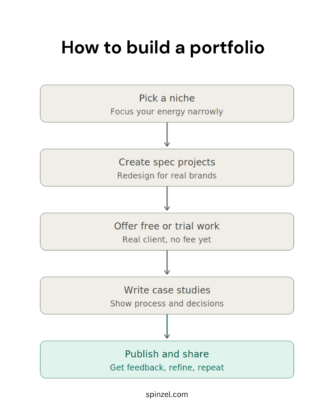
Five genuinely strong pieces will get you further than twenty forgettable ones. Clients are scanning for evidence that you understand structure, that you write for an actual reader, and that you’re not just filling space with words. That’s what a good sample proves in about thirty seconds of skimming.
This is the hardest milestone, and it’s hard for a specific reason: you don’t have testimonials yet, so you’re asking someone to take a bet on you. Here’s what actually shortens that gap.
Most beginners underprice themselves badly, thinking it’ll help them win more work. It usually just attracts clients who expect endless revisions for pennies.
Instead of asking “what’s the going rate,” ask “what is this actually worth to the client’s business?” A landing page that helps someone convert more visitors is worth more than the twenty minutes it took you to type it.
A few common ways writers charge:
Review your rates every six to twelve months. You don’t need to feel like an “expert” to raise them; a stronger portfolio, a couple of good testimonials, and repeat clients are all the justification you need.
Once you’re past the “getting any client” stage, growth comes from a few specific moves, not from grinding longer hours.
Specializing in areas that actually pay, such as SaaS, finance, healthcare, cybersecurity, AI, and B2B in general, tends to pay better because the subject matter requires real understanding, not just clean prose. Generalists compete on price; specialists don’t have to.
Keep showing up somewhere visible. A LinkedIn profile that’s actually active, with real insight rather than recycled tips, brings inbound interest before a client ever searches a marketplace.
Ask happy clients for a testimonial. Most will say yes if you just ask — they rarely think to offer one unprompted.
And where you can, push toward recurring work instead of one-off gigs: four blog posts a month, a weekly LinkedIn post, a monthly newsletter. Recurring clients are what actually stabilize a freelance income, because you stop starting from zero every month.
There’s no clever shortcut here. You get better by writing regularly, pitching consistently, and treating the rejections as information instead of a verdict on your ability. Some pitches will go nowhere. Some projects won’t go the way you planned. That’s not failure, that’s just what the first year of any freelance career looks like.
Start before you feel ready. That’s the whole trick.
How do I become a freelance writer with zero experience?
Write your own samples, publish them somewhere visible, learn the SEO basics, and start pitching small projects. A strong portfolio beats a resume every time.
Can this become a full-time income?
Yes, the writers who make it sustainable usually specialize, hang onto long-term clients, and move into higher-value work like copywriting or content strategy over time.
What is the best platform for beginners?
Upwork, Fiverr, ProBlogger’s board, and LinkedIn are solid starting points. Just don’t rely on only one.
How much do beginners actually earn?
It varies a lot based on niche, pricing model, and consistency. Most people start with smaller projects and raise rates as their track record grows.
How long until the first client?
Anywhere from a few weeks to a few months. The writers who land one faster are usually the ones pitching consistently, not the ones with the most natural talent.